Tap to View
𝗖𝗢𝗟𝗟𝗘𝗚𝗘 𝗡𝗘𝗪𝗦 | LPC strengthens Research Production, Publication, and Innovation to advance Academic Operations and Community Extension
Date Posted: Oct. 25, 2026
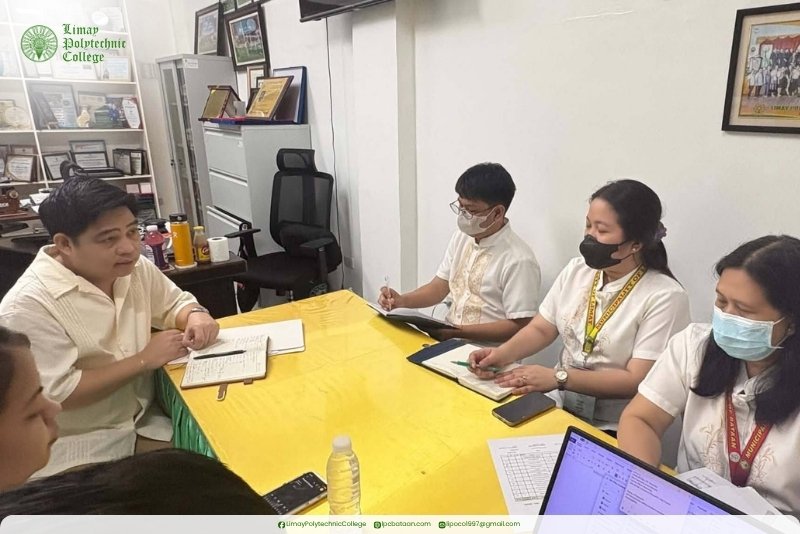
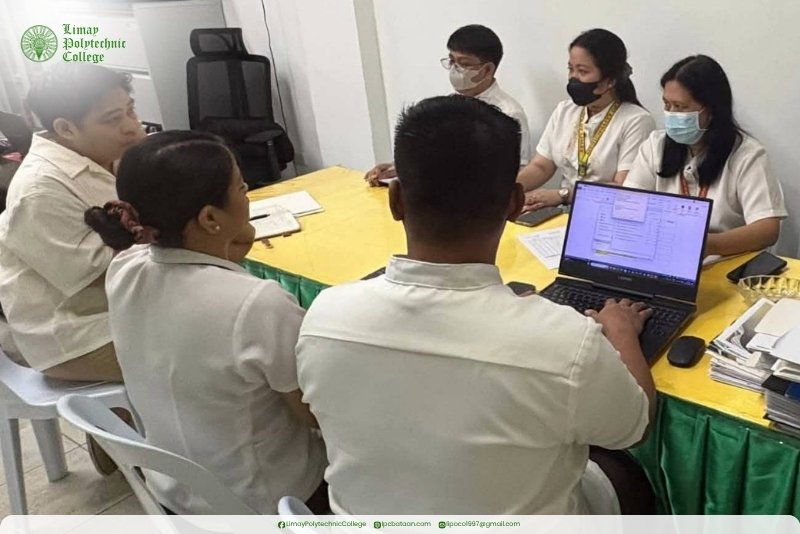
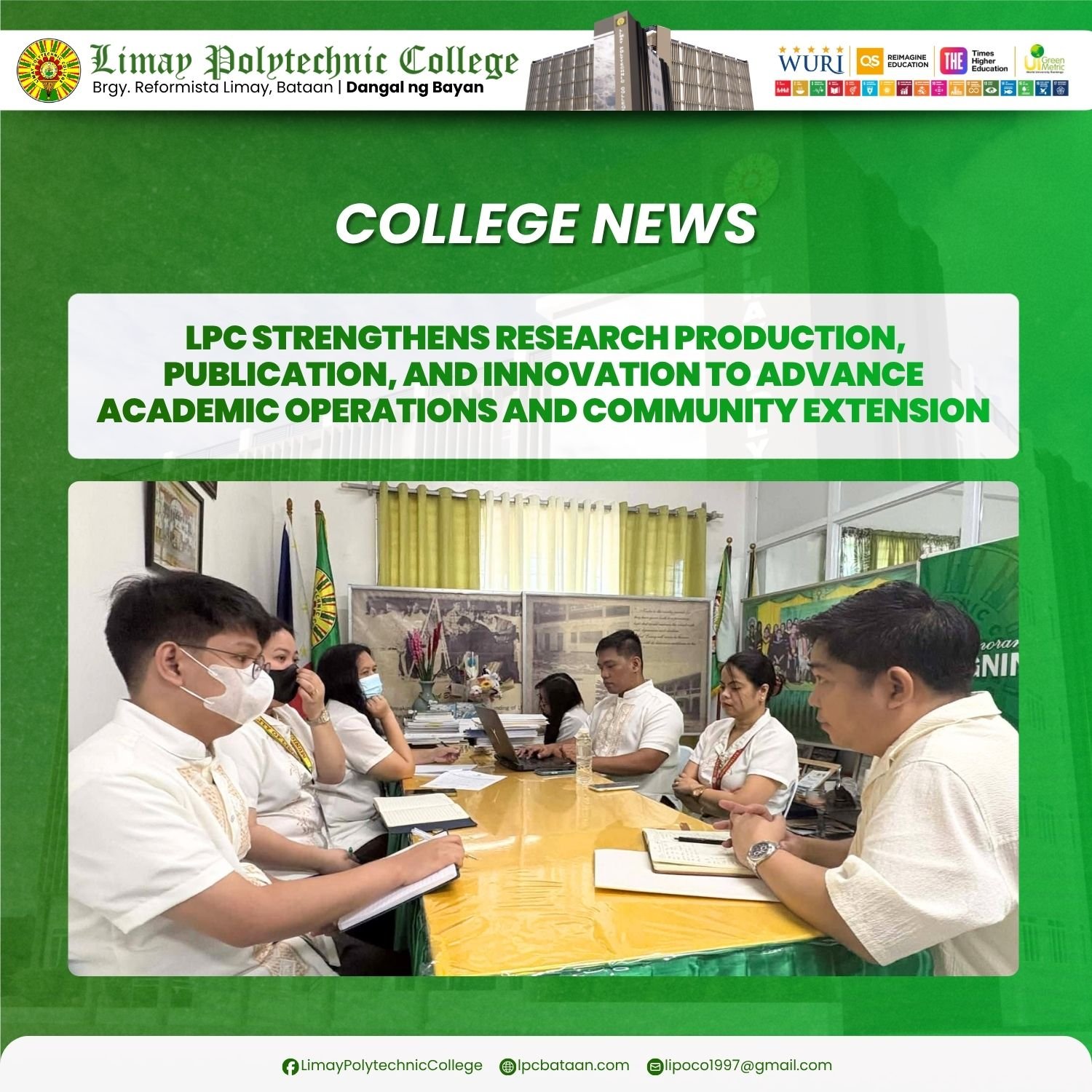
Limay Polytechnic College (LPC) is intensifying its institutional research agenda to strengthen research productivity, scholarly publication, innovation, evidence-based decision-making, and community development, following a strategic meeting of the LPC Research Council convened by College President Dr. Elmer B. De Leon on October 19, 2026, at the Office of the College President.
The said meeting brought together the Research Council led by Mr. Joemark Ablian, Director of the Center for Research, Innovation and Extension (CRIE) to assess current accomplishments, examine prevailing challenges, and establish strategic directions and immediate interventions for strengthening the College’s research culture.
Dr. De Leon reiterated the need to give greater priority to research as a fundamental component of higher education, emphasizing quality research production, dissemination, publication, development, and innovation.
He underscored that research must go beyond meeting regulatory requirements of the Commission on Higher Education (CHED) and contribute directly to institutional operations, management decisions, procurement planning, instructional improvement, and community development.
He emphasized the importance of transforming research into practical and measurable outcomes that support continuous quality improvement (CQI), institutional advancement, and the College’s growing engagement with national and international academic communities.
Advancing Research Productivity, Publication, and International Visibility
During the meeting, Director Ablian reported several ongoing and completed research initiatives that reflect the College’s continuing efforts to strengthen research production and scholarly engagement.
A number of research proposals are lined up for contract signing and research proposal colloquia, where proposed studies will undergo peer review, critique, and refinement.
Completed research studies are also being prepared for conference presentations and submission to reputable, internationally refereed journals, with the aspiration of publishing in Q2-ranked academic journals to strengthen scholarly visibility, citation impact, and institutional research performance.
Meanwhile, the institutional research publication initiative, launched during LPC’s hosting of the ALCUR3 Student Research Conference, is undergoing final preparations for an International Standard Serial Number (ISSN) application and the corresponding recognition processes.
Research collaborations with professional organizations and academic institutions are likewise underway, with joint research outputs being pursued.
Funded research projects are progressing, with some already completed and others continuing through their respective implementation stages.
LPC students and faculty members have also been presenting their research works at various conferences, earning distinctions such as Best Abstract, Best Research, and Best Presenter.
These accomplishments demonstrate the potential of research as a platform for developing scholarly competence, professional confidence, innovation, and academic recognition.
Commending these developments, Dr. De Leon challenged the College to pursue 100% research engagement among full-time faculty members, aligned with the institutional research agenda and development priorities.
The target seeks to broaden participation in research and establish scholarly inquiry as a sustained academic responsibility rather than an activity limited to selected faculty members.
Identifying Research Challenges Through Continuous Quality Improvement
To establish a more responsive and sustainable research culture, the Research Council reviewed the prevailing conditions affecting research productivity and identified five major areas requiring institutional attention:
1. Research capacity, efficacy, and ideation — strengthening researchers’ competencies, confidence, and ability to develop relevant, feasible, and quality research proposals.
2. Research interest and motivation — encouraging faculty and personnel to pursue research through relevant topics, professional development, institutional recognition, and appropriate incentives.
3. Research engagement opportunities — expanding access to research conferences, training programs, collaborative projects, professional networks, and community-based research initiatives.
4. Technical research competencies and tools — improving access to statistical analysis, methodological support, transcription, thematic generation and analysis, editing, and other technical processes essential to producing quality research outputs.
5. Research time and institutional support — balancing faculty research responsibilities with teaching loads and student research supervision, while strengthening CRIE’s capacity to provide timely and responsive assistance to faculty researchers and student researchers.
The review highlighted the need for a more systematic institutional approach that addresses both researcher development and the operational conditions necessary for quality research production.
Strategic Interventions to Strengthen the Research Culture
Following its assessment, the Council identified several interventions for implementation, subject to the necessary institutional review, approval, and resource availability.
1. Research Training Needs Assessment and Mentoring - A research training needs assessment will be conducted to determine priority areas for capacity building among faculty members and other personnel. The results will guide the development of targeted training programs, mentoring arrangements, and technical assistance. A separate support mechanism will also be explored for personnel whose responsibilities include research-related administrative and technical functions.
2. Research Incentivization and Workload Support - The Council will revisit the approved research incentivization policy and explore appropriate implementation measures to encourage faculty participation in research, publication, and innovation. Possible workload adjustments or deloading arrangements may also be considered, subject to institutional policies, workload requirements, and available resources.
3. Expanded Research Engagement and Collaboration - The College will assess invitations for research training, presentations, collaborative activities, and community- or agency-based research opportunities. These engagements will be reviewed by CRIE to ensure their relevance to institutional priorities, alignment with the research agenda, and financial feasibility.
Participation in external research activities is expected to expose faculty members to broader research perspectives, strengthen professional networks, and facilitate knowledge exchange with other institutions and organizations.
4. Procurement of Research Tools and Technical Systems - The procurement of appropriate research tools and technologies will be prioritized to improve the efficiency, accessibility, and quality of research processes. The initiative may include tools supporting statistical analysis, qualitative data processing, transcription, editing, and research management, subject to technical evaluation, procurement requirements, and budget availability. The technical team may also develop or recommend systems that streamline research operations and strengthen institutional support for researchers.
5. Organization of a Core Research Team and Strengthened Advising - The College will pursue the organization of a Core Research Team to provide technical assistance, mentoring, and research support. The selection and empowerment of research advisers will also be reviewed based on qualifications, demonstrated performance, and research competencies.
Furthermore, the possibility of reducing the number of student research groups assigned to individual faculty advisers will be examined through the Academic Council, taking into account applicable policies, faculty workload standards, and institutional capacity.
The objective is to provide more focused supervision and improve the quality, completion, and timely production of student research outputs.
Immediate Actions and Institutional Commitments
To translate the Council’s recommendations into concrete measures, the following actions were identified for immediate follow-through:
(1) Integrating research into the midyear in-service training. Research will again be prioritized in the College’s midyear training program, guided by the results of the research training needs assessment and complemented by proposal colloquia, research presentations, and contract-signing activities.
(2) Deliberating on research incentives. A meeting with the Finance Team will be scheduled to examine the financial implications, funding availability, and implementation requirements of research incentivization. Also, research recognition in addition to including research in ranking and merit system and revitalizing commissioning of needed institutional researches would enhance research engagement and productivity.
(3) Reviewing external engagement opportunities. Invitations for training, research collaboration, academic presentations, and other engagements currently received by the Office of the College President will be referred to CRIE for prioritization and appropriate funding consideration.
(4) Advancing research tool procurement. Proposed research tools will be assessed upon receipt of provider presentations and proposals, in accordance with applicable procurement procedures. The technical team will also explore systems that can support efficient research operations.
(5) Strengthening research staffing and advising arrangements. The organization of the Core Research Team, selection of qualified research advisers, and possible adjustments to student research supervision loads will be reviewed with the Academic Council and other concerned offices to ensure alignment with institutional policies and standards.
Dr. De Leon further directed CRIE to regularly review the institutional research agenda, incentivization policy, and research budget plan to ensure that priorities remain relevant, implementation remains feasible, and the necessary resources are considered in institutional planning.
He also emphasized that community-based projects, instructional materials, reference books, and systems developed for institutional use may provide opportunities for further scholarly investigation and publication, where appropriate and supported by rigorous research methods. This approach seeks to maximize the value of institutional initiatives by generating documented evidence, research-based improvements, and potentially publishable outputs.
Recognition of outstanding research performance and achievements will likewise be sustained, with opportunities for appropriate incentives to be explored in support of a stronger research and innovation culture.
Research Council Membership and Governance
The LPC Research Council serves as the institutional body responsible for supporting research directions, coordinating research initiatives, and recommending measures to strengthen research productivity and quality.
Its composition is as follows:
Oversight Adviser: Dr. Elmer B. De Leon, College
President
Chair:
CRIE Director: Mr. Joemark Ablian
Members: Academic Department Heads
Faculty and Student Representative: Ms. Catherine Ambrocio
Non-Teaching Personnel Representative:
Mr. Dominic Primero
Student Services Representative:
Ms. Jesica Marata
Secretariat: Mr. Joey Gueva, CRIE Assistant
Through this multidisciplinary composition, the Council seeks to integrate the perspectives of academic departments, faculty members, administrative personnel, and student services in shaping a more inclusive, responsive, and productive institutional research environment.
Building a Research-Enriched Local College
The strategic meeting reflects LPC’s determination to strengthen research as an institutional driver of academic excellence, organizational effectiveness, innovation, and community transformation.
By investing in researcher development, expanding scholarly collaboration, improving access to technical tools, strengthening research supervision, and supporting publication and dissemination, the College aims to establish a sustainable research culture that benefits both its academic community and the communities it serves.
Under the leadership of Dr. De Leon and through the coordinated efforts of CRIE and the Research Council, LPC reaffirms its commitment to making research a more visible, accessible, and productive component of institutional life.
The College’s direction is clear: to move beyond research compliance toward research productivity, beyond individual scholarly efforts toward institutional collaboration, and beyond completed studies toward published knowledge, practical innovation, and measurable community impact.
Through continuous quality improvement and sustained institutional support, Limay Polytechnic College aspires to become a research-enriched local college where knowledge creation informs decision-making, strengthens teaching and learning, advances innovation, and contributes meaningfully to sustainable development. #
#SDG4QualityEducation