Tap to View
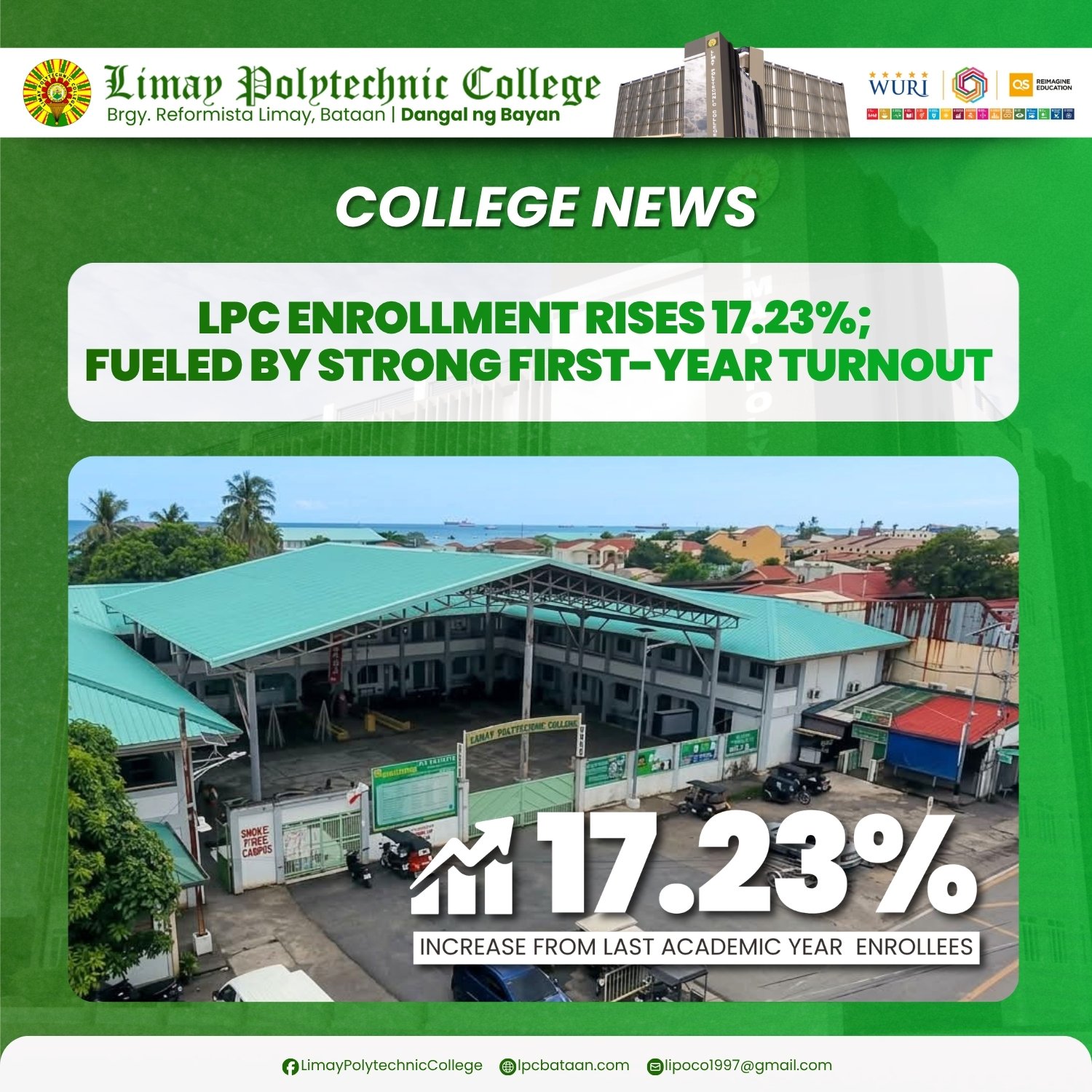
𝗖𝗢𝗟𝗟𝗘𝗚𝗘 𝗡𝗘𝗪𝗦 | LPC enrollment rises 17.23%, fueled by strong first-year turnout
Date Posted: Aug. 10, 2026
A remarkable sharp inclined enrollment rate eyed this S.Y. 2026-2027; analyzing 17.23% increase threshold.
Limay Polytechnic College recorded a total enrollment of 2,000 students for the 1st Semester of AY 2026–2027 noting 17.23% increase with that of the previous schoo year reflecting a strong demand for its academic programs, according to the Report from the Registrar's Office.
In a presented report, female students comprise 63.7% of the population, while male students account for 36.3%. The enrollment profile is characterized by a notably large first-year population representing 41.15% of total enrollment, demonstrating sustained demand and increasing institutional attractiveness.
In the light of geographic segmentation, students from Limay dominates big portion of the population, bearing 74% against 26% outside Limay, preferably coming from towns of Orion, Mariveles and Pilar. Based on barangay distribution, greatest portion comes from Saint Francis 2 which is just nearby the school holds 33% of the total population.
Business Administration has the largest program cluster with 40.65% of total enrollment, followed by Teacher Education with 38.75%. Together, these two academic areas account for approximately 79.4% of the College's total enrollment. BSBA Marketing Management is the largest individual major carries 18.5% of total population and 44.65% of the Business Program, followed by BSED English comprising 16.15% of total population and 41.88% of the Teacher Education Program. ACT Multimedia also contributes a significant of 12.15% of total enrollment.
On a year level threshold, first year level enrollment marks the biggest number of share in the total enrollment with 41.15%, the biggest so far in history enrollment; while seond year level holds 27.6% share, the third year level takes 17.4% and the fourth year has 13.8%.
The progressive decline in headcount across year levels from first year students to fourth year students entails cohort-based analysis.
While this pattern cannot by itself be considered an attrition rate because the figures represent different cohorts and program structures, it highlights the importance of strengthening student retention, progression, and completion monitoring.
The slight attrition rate observed in the last five years, it can never indicate a decline because of the continuous enrollment spike in the six year cohort rate trajectory. In this context, LPC's continuing enrollment growth is primarily driven by the strong and increasing influx of freshmen, while student retention and promotion to the next level remains relatively stable.
Notably, the remarkable 100% retention obtained by the Accountancy Program, while 95% by Business and Teacher Education Programs also contributed to the current institutional population. As such, most of those counted for the attrition rate, have secured and processed a leave of absence due to reasonable and acceptable conditions as approved by the Office. This means, they will be returning on the intended semester indicated in the LOA. The said retention can be credited to the efforts of the Departments, through the heads, faculty and student officers for the effective and quality instruction, dynamic programs, remarkable assistance, inclusive engagement, competitive approaches and concrete outcomes.
Overall, the enrollment data demonstrate LPC's strong market demand and growth potential while simultaneously emphasizing the need for evidence-based faculty deployment, infrastructure expansion, student support, program diversification, and systematic cohort tracking.
The rising positive admission turn-out can be strongly attributed to the transformative school branding, institutional achievements and testaments of both satisfied current students and successful graduates which is presented in a separate article on Analysis of Retention Cohort Rate: Grounded on Making LPC an Institution of Choice. It can also be accounted on the sustainable smarter, more effective and organized school campaign and promotion and admission process implemented by Ms. Fatima Racion who also keeps on following up and communicating with prospective enrollees.
Based on the marketing research data supported by the emic and etic interviews, the following are thematic reasons for making LPC become a school of choice: (1) Successful graduates and impressive board performance; (2) World ranks and branding; (3) Quality instruction (supervised and monitored onsite learning with structured alternative learning continuity frameworks; (4) Well performing and qualified faculty; (5) Dynamic student co-curricular activities; (6) Satisfactory student services and approachable staff; (7) School's achievements; (8) Scholarship opportunities and assistance; (9) Student engagements and career opportunities
10. Free tuition and airconditioned classrooms.
The figures provide a strong basis for institutional planning, resource allocation, academic program development, and the College's continuing pursuit of student success.
Hence, LPC has successfully attracted students who begin to value the school as an institution of choice. The next strategic challenge is to ensure that these growing population of students, particularly the freshmen are retained, supported, and progressed through quality programs, services, flexible learning systems, and scholarship and financial assistance toward graduation and employment opportunities provided and assisted by the college.
That is where enrollment growth is converted into sustained student success as one parameter of LPC's institutional strategic direction under Pathway 4: Remarkable Student Success, Empowerment and Services imbued with SDG 4 (Quality Education), SDG 10 (Reduced Inequalities) and SDG 8 (Decent Work and Economic Growth).
The whole report on this matter presents comprehensive data and comparative analysis. The Office of the President commends the Registrar’s Office through Ms. Marites Pacquing for providing comprehensive, accurate, and timely enrollment data that serve as a valuable basis for institutional analysis, planning, and decision-making. #
#SDG4QualityEducation